Thursday, June 5, 2014

Breaking up is hard to do

Impatiens niamniamensis was my favorite houseplant.  It was loaded with striking flowers, grew fast and generally made my room feel more tropical.  I found that I am not the only one to have been seduced by this Central African native.  You can see some great photos and read somebody else obsess over the "Congo Cocatoo" at Stupid Garden Plants.


Alas, it was a love that circumstance would not allow.  The plant had just started to put out a ridiculous number of new flowers when I noticed a torrent of ants streaming to and from its pot.  It seemed the ants and I could both agree that the Impatiens niamniamensis blooms were extremely enchanting. Convoys of the little critters went in and out of the flower openings. I was curious to see what all the fuss was about so I bit open one of the flowers for a taste. Inside there was a fair amount of sweet nectar.  I found it similar to sucking on a Phlomis fruticosa bloom.  There also seemed to be a fair amount of extrafloral nectaries.  My camera (smart phone) can't take good macro photos, but Stupid Garden Plants has a detailed photo of these extrafloral nectaries  It's quite probable that the ants were attracted by both the flowers and these points of nectar on the stem of the plant. In its native habitat Impatiens niamniamensis might even use its extrafloral nectaries to attract ants which would then protect the plant from herbivory.  This seems to be the case with other impatiens as this study from 1990 explains: Amino Acid Concentrations in Extrafloral Nectar of Impatiens Sultani Increase after Simulated Herbivory.  In any case, the ants went nuts for this thing.

 I battled wave after wave of invading ants, I moved the plant to a different room, I filled a saucer with water to act as a moat, but still the ants kept coming with frenzied passion.  What seemed like the beginning of a long happy plant relationship had turned into a messy love triangle between me, the Congo Cockatoo and thousands of ants.  Not knowing how else to proceed, I banished my Impatiens niamniamensis from my indoor plant collection.

Within one day of kicking the plant out of the house things got even worse.  It had always liked the strongest light I gave it indoors so I thought maybe now it would finally be able to get the sunlight it had always wanted.  So I placed the Impatiens in a spot with about 2 hours direct sunlight.  Talk about getting zapped!  I came back from work and the leaves were scorched.  If your curious to see what happens to Impatiens niamniamensis in direct light take a look:

The white portions of the leaf may look like the sun reflecting off a glossy surface, but in fact this is just necrosis of the tissue.
Currently this sad Parrot Impatiens sits in dark corner of the yard.  In my room, the random stray ants left over from the heady days when nectar flowed freely now meander about aimlessly, devoid of passion.  Having I. niamnamensis in my room was beautiful while it lasted.  Perhaps when the Hoya blooms I'll be seduced all over again.

Thursday, May 29, 2014

The certain death of an albino corn seedling

I started some popcorn for my garden earlier this May and happened upon an albino corn!  Not producing any chlorophyll with which to photosynthesize, the seedling died a few days after this picture was taken.  This provides interesting insight into how far the energy stored in the seed of the corn will take the seedling.  With only the energy from its seed, and no energy from photosynthesis, the corn will grow to as big as you see the albino corn in this picture.  While the seedling can uptake some nutrients from the soil, there is no source of C6H1206, (glucose).  This 1955 article by Heinz Seltman describes the fate that awaited my albino corn:  "After 12 days the growth tips of the older leaves of the albino seedlings showed necrotic areas.  Rates of growth of the albino plants decreased from 12 to 15 days and death occurred approximately 20 days after zero time."  I had already removed the plants that I needed from the flat so these seedlings continued to grow undisturbed after this picture was taken.  Sure enough the albino seedling met its inescapable fate. It is currently little more than a crispy whisp of dead plant tissue while it's compatriots are still alive in the flat.  

Interestingly just because the albino plant produces no chlorophyll does not mean it cannot sense light.  This picture from the previously mentioned Seltman article shows how albino corn grown in the dark still exhibits etiolation:
An external file that holds a picture, illustration, etc.
Object name is plntphys00381-0069-a.jpg


While for corn, albinism means certain death, there are some species of plants which produce no chlorophyll and lead long healthy lives.  They survive via parasitism.  Check out this happy albino, Knapweed Broomrape (Orobanche elatior):


Even more spectacular looking is Monotropa uniflora:

Credit Gary Munroe


Wednesday, May 14, 2014

Bulk Density Sampling - This Time with Professional Equipment!

A while back I posted how to take bulk density samples with household items in Bulk Density Showdown. If you're wondering what bulk density even means, check out the post. The coring cylinder used in the DIY bulk density post was a simple corrugated aluminum can.  There are some drawbacks to this as the depth of the sample is limited by the short height of the can.  What's even more problematic is that the can will sometimes crumple when being hammered into the soil if the soil's bulk density is too high. The aluminum can does have the advantage of being free though!

I thought it would be nice to show how the process is done with the equipment that's actually designed for the process. Below you'll find the basic steps for taking a bulk density sample.

Here are the tools for the job.  A steel coring tube, a plastic top for pounding the coring tube into the soil, a mallet, scissors, and a rod (not pictured) which fits into the hole you see at the top of the tube.

The first step is to remove the biomass from the soil surface where you want to take your sample. Use the scissors to remove an area slightly larger than the area of the coring tube.

Next pound the coring tube into the soil.  This particular coring tube is marked out every 5 cm.  Let's say we want to measure the bulk density of the soil from 0-5 cm.  We'll hammer the tube into the soil until the first measurment line is level with the soil, ie when the tube is 5 cm deep. 


To remove the tube from the soil, insert the metal rod into the holes at the top of the tube.  Rotate the tube while pulling up.  It's important to be gentle while removing the tube lest the soil sample inside come lose and fall out the bottom of the tube.

Dump the soil from the coring tube into a plastic bag.  Allow the sample to dry completely.  Weigh the soil, then divide this weight by the volume of the 0-5 cm portion of the coring tube.  This is your bulk density.


If you want to then sample the density of the soil at 5-10 cm, put the coring tube back into the hole you have made, being careful that the sides of the hole do not cave in.  The coring tube should sit with the soil level with the 5 cm mark.  Pound the tube into the ground so that the 10 cm mark is level with the soil.  Then repeat the process of removing the tube and putting the sample into a plastic bag.  This will be bulk density of soil from 5-10cm deep.  On this particular tube you can continue sampling in 5 cm increments until 30 cm deep.  Other coring tubes will allow you to sample deeper depths.  For greater accuracy, an augured soil corer can be used.


Tuesday, April 22, 2014

Syrian Civil War Outbreak Explained in Two Graphs

While it's not actually possible to explain something as nuanced as the outbreak of civil war in Syria with merely two graphs, these do illustrate perhaps the most important factor:  A devastating collapse in farm productivity brought about by drought and soil degradation which pushed hundreds of thousands of people into poverty and off their land. You can see the drop off in 2007 in the crop produciton graph below.  If we look to why a similarly extreme drought in the late 1990s (BBC blip or in depth assessment for further info) did not lead to the social upheaval of 2011, the population growth from 1990 to 2012 in the second graph explains the different set of circumstances.  While Syrian population was 15 million in 1998, by 2009 the number had increased to 21 million.  Those extra 6 million people, a 40% increase, helped make the difference between an agricultural crisis and the disintegration of the Syrian state.

Although not nearly as important a crop as wheat, I included lentils in this graph to show how the drought affected other crops as well.  I had to multiply the production in metric tonnes by 10 for the lentils to be legible.  Data from the FAO


For an in depth analysis that covers all the causes of the conflict, this Atlantic article by William R. Polk does a thorough job. Yet despite the many other factors at play, without the collapse of agricultural productivity, it's possible and even likely the drawn out conflict never would have happened.  

To understand the severity of the drought, this quote from a 2010 Gary Nabhan article illustrates the biblical proportions of the event:

"In the past three years, 160 Syrian farming villages have been abandoned near Aleppo as crop failures have forced over 200,000 rural Syrians to leave for the cities. This news is distressing enough, but when put into a long-term perspective, its implications are staggering: many of these villages have been continuously farmed for 8000 years. As one expert puts it, this may be the worst long-term drought and most severe set of crop failures since agricultural civilizations began in the Fertile Crescent many millennia ago."

This USAID article on wheat production during the drought shows how there was "little to no measurable rainfall this year [2007] in the planting period from October-December in the primary wheat producing regions of northeastern Syria".


The drought severly weakened Syria's ability to grow food.  As farming became impossible entire regions lost their way of life. Men, families, or "entire villages" as Gary Nabhan recounts, were forced to leave their land and head to Syria's major cities. Most of the displaced farmers were from predominantly Sunni regions. The Syrian political apparatus on the other hand was mainly Alawite.  Whereas confronting the Assad regime would have been unthinkable before the drought, the desperate poverty many Sunnis now found themselves in meant they had nothing left to lose.  In March 2011 demonstrations broke out in the city of Daraa and Syrian security forces responded violently, killing four people.  Protests then spread throughout the country and breakdown of the state would soon follow.


Protests in Daraa


Although this is a story of severe environmental circumstances outside of human control, it is important not to conclude that Syrian state had no agency in the collapse of agricultural production.  Indeed it was the well intentioned but short sighted development and poor management of irrigated agriculture, especially in the arid Northeast, which set Syria up for such a catastrophic disaster when drought did arrive. As this article by Francesca de Chatel explains:

... water policy in Syria has since the 1950s been driven by a supply-side approach with a specific focus on dam construction and irrigation projects in the north-east of the country. The relentless drive to increase agricultural output and expand irrigated agriculture blinded policy makers to the natural limits of the country's resources. Unrealistic agricultural targets, corruption, a failure to implement and enforce legislation, and the absence of a long-term strategy have thus devastated a region that was considered a breadbasket for Syria and the region.
Over the past 60 years, Syria's agricultural sector has undergone intensive development, particularly in the north-east of the country. The country's irrigated area has doubled over the past 20 years from 651,000 hectares in 1985 to 1.35 million hectares in 2010. Sixty per cent of this surface area is irrigated with groundwater, which is being extracted at an unsustainable rate. Ninety per cent of the country's water goes to agriculture, by far the highest percentage in the region, with very low irrigation efficiency. Over 80 per cent of irrigated land is still irrigated through traditional flooding methods and losses in the open concrete government irrigation canals range from 10 to 60 per cent.

(Sounds eerliy like the San Joaquin Valley.)

As with many states before it, Syria is yet another example of the perils that await when a nation's soil ceases to be productive. With climate change upon us, the type of drought which brought down the Syrian state are sure to be seen in increasing number. The importance of resilient, effiecient and realistic irrigation strategies, as well as healthy soils that can retain moisture better cannot be understated.  These are not the distant goals of some far off agroecological utopia, they are steps that need to be taken immediately to prevent other states from degenerating into bloodshed.

Friday, March 21, 2014

The Plant Nutrient "They" Don't Want You to Know About

I doubt anybody actually doesn't want you to know about Silicon - I just have to come up with interesting titles here.  If you look at your basic textbook list of essential plant nutrients you usually see something like this:

No Silicon on the list, and yet from an LSU article on Silica and Rice Growth, we can see that up to 8% of rice straw is ... Silicon.  Now it's not exactly breaking news that plant's use Silicon.  As early as 1867 German scientists suspected it helped prevent grains from lodging.  In his 1993 article, The anomaly of silicon in plant biology, Emanuel Epstein notes there are clear benefits to Si, but wrestles with the idea of being able to define it as "essential".
The problem with the term "essential" that it is possible to grow plants to maturity in mediums where Silicon has been completely excluded.  The catch though is that these plants are rather pathetic compared to plants that have access to Silicon.  As Epstein writes in his 1999 paper aptly titled, Silicon

"[Silicon deprived plants] are often structurally weaker than silicon-replete plants, abnormal in growth, development, viability, and reproduction, more susceptible to such abiotic stresses as metal toxicities, and easier prey to disease organisms and to herbivores ranging from phytophagous insects to mammals."

So although Silicon is not essential for some plants in that they can conceivably live without it in a laboratory, it is possible these plants would not survive environmental stresses in their natural habitat without Silicon.   Adding further confusion to the "essential" debate is the fact that "for certain algae, including prominently the diatoms, and the Equisetaceae " Silicon is indeed an essential nutrient, without which these plants would not grow.  By 2005, Epstein and Bloom settle on the term "quasi - essential"

The takeaway from all of this is that although semantics prevent Silicon from being defined as an essential plant nutrient, it's safe to say it's rather important for a healthy plant.  It's benefits range from greater resistance to drought and pest stress to stronger cell walls (which is what helps prevent the lodging those Germans were talking about). The proof is in the pudding of course so here are some pictures from Janislampi's 2012 paper, Effect of Silicon on Plant Growth and Drought
Stress Tolerance.  Check out the artilce for more pictures.


And although the world of plant nutrition may not have fully embraced silicon's importance, cannabis nutrient companies are all over it.


In time I think the table of essential plant nutrients from the very beginning of this post will be but a relic.  Until then, don't forget to give Silicon the credit it's due!

Wednesday, March 5, 2014

Fertilizer Subsidies in Malawi

Inline image 4
From the great NY Times article on the subsidy program.
The "Billions of metric tons" is an error though and should
say millions.
The recent success of Malawi's fertilizer subsidy program is a perfect example of the role that soil can play in the well being of a state.  In the early 2000s, Malawi faced grave challenges feeding itself.  In 2005, over a third of its population, 5 million people in a country of 13 million, needed emergency food aid. Only 1.2 million metric tons had been produced in that years dismal corn harvest.  Yet the very next year in 2006 the nation had a record harvest - 2.6 million metric tons of corn. One year later this new record was smashed when farmers harvested 3.2 million metric tons.  The increase in production has been maintained as well, with 2013's corn harvest coming in at 3.6 million metric tons.  How did the nation pull itself back from the brink of famine so effectively?  Increased soil fertility.

Inline image 3In 2006 Malawi initiated its Farm Input Subsidy Program or FISP.  The program subsidized several inputs, the main ones being fertilizer and seed.  Two fertilizers were provided at reduced cost to farmers, Urea with 46-0-0 and NPK 23-21-0 +4S. Despite its name, the NPK fertilizer has no Potassium although it does contain Sulfur.  Fertilizer use increased dramatically due to the program and as a consequence farmers obtained record yields.

Not only did this mean that there would be adequate supplies of food for the population, but for an agrarian nation like Malawi, such an impressive jump in production can really boost the economy. Indeed, many observers have credited the implementation of the subsidy program for the country's economic growth with GDP almost doubling between 2005 and 2011. The FAO stats on agriculture production show a clear trend.  Before the FISP in 2005 Malawi produced $150 million of corn and roughly the same value of tobacco, by 2012 those figures had risen to$430 million worth of corn and $240 million worth of tobacco.  It is important to note here that the majority of corn produced is consumed locally, but tobacco harvests, an important export crop for Malawi, clearly benefited from increased use of fertilizer.

There's nothing like a side by side crop comparisons to drive home the impact of the program.

Inline image 2
Corn field with fertilizer on the right, without on the left. Malawi 2007. Source Duffel

Inline image 1
Corn in the foreground without fertilizer, corn in the background with fertilizer.  From Ntchisi, Malawi 2009.  Note that you can see a trademark foliar symptom of N deficiency on the corn leaf just above the "Nt" where "Ntchisi" is written in the first line of this caption.  The lower leaf shows chlorosis, but in an arrow like streak that goes down the center of the leaf.  K deficiency on the other hand usually presents itself as chlorosis on lower leafs but more on the edge and without the arrow streak down the center.

Corn produciton now is sufficient to feed Malawi's population
This chart from a study documenting the FISP.
It seems safe to say that Farm Inpust Subsidy Program succeeded in increasing corn production and spurring economic growth.  The country now no longer lives with the threat of famine and (huge understatement here) this makes for a much more stable nation state.

The future of Malawi's soils management

There are problems with the program however and I think the critiques can be put into two categories. There are issues with prolonged use of urea fertilizer and soil health and then there are concerns about the levels of government spending to support the subsidy program.  There is also the problem of malnutrition due to over dependence on corn (Malawi is the third highest per capita consumer), but this is not necessarily the direct fault of the FISP.

The government currently spends a good deal on the subsidy program, somewhere around 9% of government spending.  As one Oxfam blog points out, while one ton of imported corn can support five families for 96 days, the same amount of money spent on fertilizer subsidies would allow them to produce enough food for 10 months.  Clearly producing corn isn't quite as simple as subsidizing fertilizer but the point is valid- it makes more sense to invest in fertilizer when the alternative is importing food from abroad.  Things get tricky when the price of synthetic nitrogen fertilizer increases as it did in 2008.  The program costs jumped from a little over $100 million to around $225 million.

The production of urea is a rather energy intensive endeavour, requiring 2-3% of the world's annual production of natural gas.  Increasing demand for synthetic nitrogen and finite supply of natural gas means the cost of urea will continue to rise.  This begs the question, when will Malawi no longer be able to afford its subsidy program.  It also begs the question, when will we all starve if we continue to rely on synthetic N to feed ourselves, but that's a whole other blog post!

Olivier de Schutter, UN Special Rapporteur on the Right to Food, has also lamented how the FISP swallows up more than half of Malawi's agricultural budget and prevents investments in more sustainable approaches to increasing yields.  He gives us a nice segueway to the other major problem with the FISP in this news clipping:

“It is time for Malawi to move beyond the fertilizer-led “green revolution” and invest in the Brown and Blue Revolutions needed to rebuild soil fertility and water retention,” the Special Rapporteur urged. He noted that the integration of legumes in cropping systems and agroforestry systems in Malawi are yielding more food than fertilizer-driven systems while rapidly restoring soil fertility. They are the foundations of sustainable food security. He emphasized the need to move away from the maize economy, and to link agricultural development to nutritional needs, an indispensable condition for lasting victories over malnutrition.

Prolonged use of urea fertilizer has been shown to acidify soil, decrease cation exchange capacity, and decrease exhangeable Calcium and Magnesium.  Using only Nitrogen, Phosphorus and Sulfur as the sole fertility inputs on fields while extracting record breaking yield of corn from the soil will surely lead to demineralization.  All the other essential plant nutrients other than N, P and S that are being removed from the soil with each harvest are not being replaced with the current fertilizer regime.  So although the FISP is clearly boosting productivity, it relies upon constant input of chemical fertilizers year after year, and at the expense of long term soil health.  There is no improvement of soil fertility here beyond the year the fertilizer is applied as opposed to cropping systems which apply substantial amounts of organic matter. If the FISP were to stop, the legume and agroforestry systems that de Schutter metnions would be able to continue producing while the soils dependent on chemical inputs would see yields collapse.

Don't get me wrong, the synthetic fertilizers of the subsidy program are currently what feed Malawi and credit should be given where it's due.  However the simple fact that the FISP is the only thing standing between Malawians and famine points to the need for a more enduring solution to improved soil fertility that ideally is accessible to farmers without government intervention.  The enduring solution is of course alternative pathways to soil fertility that don't rely on imported chemical fertilizers that no one can actually afford on their own.  Legume cropping systems, agroforestry, composting, proper recycling of human waste, and the recapture of fertility from other waste streams will all have to become more important.  Urea is an extremely convenient source of fertility for the end user, a 50 kilogram sack that is 46% N by weight.  However onsidering the complicated process required to make this product puts this supposed convenience into perspective.  Alternative sources of fertility will also need to be relatively complex in that a series of complimentary components will be needed.  One single source will not be sufficient in order to meet the demand that synthetic fertilizers currently satisfy.  Just as the Green Revolution depended on multiple innovations in order to function, so to will any attempt to replace chemical fertilizers.  Wether one supports the use of chemical ferilizers or not, the facts stand that they feed much of the world and we will not have access to them forever.


Faidherbia albida - a nitrogen fixing tree.   The tree's ability to increase the fertility of the surrounding soil is evident in the picture.


Monday, September 30, 2013

Bulk Density Show Down

Bulk density is a measure of how porous your soil is.  It is the mass of soil without moisture divided by the volume of that soil.

Mass of Soil (dry)
Volume of Soil

A very high bulk density means the soil is very compacted, while a low bulk density means there is lots of pore space for air and water in the soil matrix.


As this handy table from the USDA shows, once you reach around 1.5 g/cm3 plant growth suffers.


Measuring bulk density on your own is extremely easy.  To demonstrate the process I pitted my lovingly tended vegetable garden against a riparian zone in a local park. What site would come out with the lower bulk density?  Would the minimal tillage and copious amounts of organic matter I dump in the veggie patch every season be enough to match the virgin uncultivated porosity of Glen Canyon's creeksides?


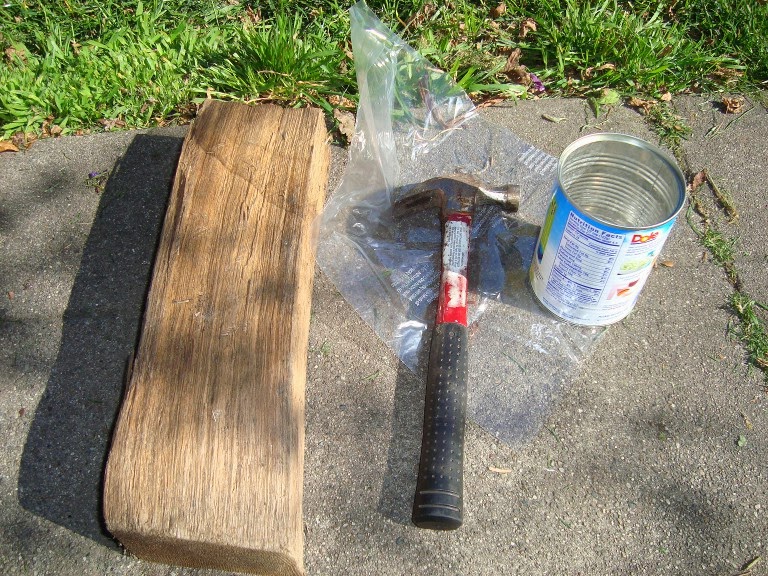
First, I had to gather my high tech soil sampling equipment.  Block of wood, plastic bag, hammer, and aluminum can. Check. 


It's important to know the volume of your sample.  If you're using a can that had food in it, the volume is usually written on the label.  If not, simply fill the can to its top with water and then measure this quantity of water in a measuring cup.  Once you're set with the volume of your can, cut both the top and bottom out.  It's nice to use a sturdy can with corrugated sides.  Unfortunately we can only ask so much of our aluminum cans and when you're dealing with really compacted soils it's possible the can will buckle.  In this case you actually do need a more sophisticated steel ring.

Once you're out into the field clear away any plant matter on the soil surface and pound the can straight into the ground using the block of wood to evenly distribute your impressive hammer blows.


Pound until the can is flush with the ground.


Now the trick is to remove the can from the ground without losing any soil.  I find it's easiest to dig out around the can a little bit.


Gently pluck the can from the ground and slip it into your sample bag without losing any soil.


I dry the soil in an oven at very low temperatures.  Whatever the lowest temperature you can use the oven at should be fine.  Once the soil is dry, you can weigh the sample.  Divide this weight by the volume of the can and you have your very own bulk density data.

So how did my vegetable patch fare against the riparian zone?

Veggie patch, 1.08g/cm3


Glen Park, 0.85g/cm3


The veggie patch came out the gates strong with a low 1.08g/cm3, but it's just not enough to match the sylvan sanctity of Glen Park's 0.85g/cm3.

Was my sample spot in the veggie patch too close to a pathway? Perhaps.  Could the different soil textures of the samples account for some of the difference? Probably.  Should I find a weaker competitor for the veggie patch next time? Definitely.


Thursday, August 29, 2013

Friday, July 12, 2013

Phosphate and Nitrate Algal Bloom in the Yellow Sea... Again


Once again a massive algae bloom has occurred off the shores of Qingdao (青岛). You may recall that the last time this occurred in 2008 Qingdao was just months away from hosting the Olympic sailing competitions. A massive clean up effort cleared the waters in time for the events but the underlying problem of fertilizer runoff is still very present. Phosphate and nitrate runoff from excessive fertilizer use in Shandong Province empty out into the waters around Qingdao. Combine this heavy nutrient load with the right weather and a massive algae bloom (410 square km according to The Telegraph) is the result.

Zhang qiao pier


Recognize that pier now?


I'll admit that much of the world's population depends on synthetic nitrogen fertilizer and mined phosphorus to provide them with food. However, the excess amounts being applied to Chinese cropland is ridiculous. In a great National Geographic article about nitrogen fertilizer, Dan Charles describes how one rice farmer is using 530 lbs. of nitrogen per acre, while some vegetable growers are using 800 or even 1600 lbs. per acre!

We can see how the majority of nitrogen fertilizer used for crops comes from synthetic sources.  We  can also see that we are applying more than is taken up by crops.


Using the great Roots Tubers & Bananas Maps from CGIAR we can really get a sense for just how excessive fertilizer use in China is compared with the rest of the world.  

Phosphorus use
Nitrogen use

There are dramatic well documented health and environmental problems this type of fertilizer use causes.  What I think is even more concerning though is that these fertilizers come from non-renewable sources.  Phosphorus is currently mined in a few countries - there is not an endless supply in these mines.  The way that synthetic nitrogen fertilizer is produced requires enormous amounts of natural gas- although cheap now this will eventually become more expensive as reserves dwindle.  

As the sources of these fertilizers become scarcer prices will increase.  Poorer nations will be the first to be priced out of the market. Indeed, fertilizer is already difficult to procure for farmers in developing countries.  If we are concerned about the stability of world food production, and the political stability of countries who will be first affected when production falters, we need to take a closer look at fertilizer use.

Alternative sources of fertility are readily available and often times cheaper than chemical fertilizer when the appropriate infrastructures are set up.  In addition to switching to renewable fertility sources, regulation needs to be set up to manage fertilizer runoff.  Most people would agree that dumping toxic pollutants from a factory should not be allowed, so why should applying fertilizer in quantities that will obviously lead to nitrate run off be treated any differently?

Friday, June 14, 2013

Biochar and oats

I purchased a sack of biochar a while back from what I would consider the most reputable source in my state.  I took one section of a bed and incorporated biochar into the soil, the other section received no biochar.  I applied compost and azomite to both sections. Kynon oats were then planted in both sections.

It looks as though the biochar has locked up some nutrient as the oats which received no biochar performed much better.  I used biochar on some different crops but didn't see this type of pronounced affect.  It's also possible there was gopher damage to the one end where the biochar was applied.  If the biochar did cause this though, then it might not be a great soil amendment for short term results.  At the very least it would be good to know what nutrient was being locked up and apply that along with the biochar.


Saturday, October 6, 2012

Sorghum Puzzler

Last January I was trying to see if applying fish emulsion could help some Oats that had yellowing leaves and seemed to be struggling.  Now where the sorghum is growing on the same area it is doing much poorer than where nothing was applied. The fish emulsion jug had no label but I later found out that the fish emulsion, 3-1-1, was actually 1% urea and 1% ammonical nitrogen! I really prefer my N to go into the beds in an organic form.  The oats seemed to yield better with the fish emulsion, but now the sorghum which followed is doing poorly compared to the control section.  Could more of the soil OM been somehow oxidized with the N application??  I asked a soil scientist and was told that generally additions of N are always correlated with net increases in OM.  Perhaps then the oats which received the fish emulsion were more vigorous and took more nutrients from the soil than the oats that did not receive fish emulsion.  Or perhaps it is that Sorghum, when faced with a low N situation  grows taller and lankier?  You can see that the taller Sorghum does appear to be a tad N deficient compared to the smaller but lusher green Sorghum in the plot which had earlier received fish emulsion.  Post a comment if you have any ideas what could be going on.


Ancient wisdom on compacting wet soil

The earliest surviving work of Latin prose is Di Agricultural by Cato the Elder.  It's an interesting manual that deals mostly with running a large wine and olive operation.  It is evident though that even highly specialized farms in his time were somewhat self sufficient in that all the workers (usually slaves) and animals were fed from the farm and many of the building materials for baskets and trellises were sourced from on site.  The crops in order of importance are listed as vineyard, irrigated garden, willow planting, olive orchard, meadow, grain land, planting of forest trees for foliage, vineyard on trees and acorn wood.  It was assumed that the olive oil and the wine were to be the principal source of income, everything else was mostly for the maintenance of the farm organism.

I found one passage especially interesting:

Terram cariosam cave ne ares, neve plostrum neve pecus inpellas. Si ita non caveris, quo inpuleris, trienni fructum amittes.


Beware of plowing soil that is wet above and dry below, or of driving a wagon or flock over it.  If you do not beware you will lose three years profit where you have driven over the land.


Here Cato uses the term "cariosum", which the translator Brehaut uses Columella's (another old Roman) description to explain: "Whenever plowing is done, we shall be on our guard to keep the soil from being worked when it is muddy or when it is half wet from light rains, which state of soil farmers call varia or cariosa.  It means when after a long drought a light rain wets the upper part of the soil but does not reach the lower part."

I remember working on a farm where the tractor had been driven a little to early through a wet field and for the rest of the season there were deep tire ruts that dried into rock hard compacted trenches that water could not penetrate.

So what was good for the soil in the second century BC is still good for the soil today.  Though looking at the above picture one might as well phrase it, what was bad for the soil in the second century BC is still bad for the soil today.

Sunday, September 30, 2012

I had some corn earlier in this season that had interveinal chlorosis. It seemed like it was on the new leaves so I thought at first could be an Iron or Manganese deficiency.  I checked the soil test and we had the desired levels of Iron and Manganese but our pH was 7.2.  At pH 7.5 Iron and Manganese are hard for plant to access. Someone else looked into this and pointed out that it was probably Sulfur since there was only 5ppm (missed that one!).  I had applied Sulfur in the spring to remedy that but perhaps since it was the granulated form it wasn't very plant available by the time the corn needed it.

So in order to test the hypothesis that it was indeed sulfur that was deficient I applied a foliar solution to the leaves of certain plants.  If sulfur was the deficient nutrient than the interveinal chlorosis would improve after some time.  Unfortunately elemental sulfur is hydrophobic and I didn't have any wettable sulfur so I used Iron sulfate, Zinc sulfate and Manganese sulfate, thinking that if all three worked it would be clear that sulfur was deficient, and if only one resolved the chlorosis then that would be the deficient nutrient.

I would say in general all the corn looks better, but the corn I treated with Iron sulfate didn't show as much dramatic change and I think this might be because it was quite chunky and hard to break up into a powder to get a good solution.  The Manganese sulfate and Zinc sulfate treated corn had a much clearer change.  You can see the two plants where I applied Manganese sulfate in the pictures. Interestingly the old leaves didn't seem to recover that well compared to the new leaves which might point again to the nutrient deficiency being Sulfur since S can be mobile when there is sufficient N.


Corn with Manganese sulfate applied foliarly at 10g/L at Day 1, Day 8 and Day 15

Friday, September 21, 2012


Think of the most iconic breakdown of a state, the most classic revolt of a people against the existing power structure. For many, the French Revolution immediately comes to mind.  Clearly this was a complex event with many factors, but if one were to simplify its causes, wheat is what brought the downfall of the French monarchy.  Wheat harvests had been poor since the 1783 volcanic eruption of Mt. Laki in Iceland and exceedingly harsh winters in 1788 and 1789 had further decimated the wheat crop.  Over the course of 1879, the price of bread rose 67% from 9 sous to 15 sous.  The average French worker was earning 15 to 30 sous a day. In order to afford the two loaves of bread needed to feed a family of four, the worker would then be spending 100-200% of their income on food.


It seems that when more than 40% of income is spent on food social unrest is likely.  Other factors such as a highly extractive government or perceived corruption will help to ensure that this turmoil is aimed at replacing the current state.  So in the case of late 18th century France, with 100-200% of income spent on food and heavy taxes being levied by a corrupt elite to fund a lavish lifestyle, a dramatic revolution seems natural.


Would this revolution have happened had there been a bountiful wheat harvest? Or if French farmers had adopted alternative crops like the potato and food prices remained stable?  I for one do not think so.  It's possible to aruge it was worthwhile in the long run to have these food shortages since it ended feudalism in France, but the point is that agronomy had a direct impact on the direction of the French nation.


Eventually I hope to explore this connection between the stability of nations and their agricultural practices in greater detail.  It is a connection that plays out not only in history but across the headlines of today's news.  Amongst the chaos and violence of a collapsing of nation, it is easy to forget the farmer in his field and the quiet events that preceded these dramatic political convulsions.  But we must fully appreciate how much power the farmer and the soil that he works truly have.  To not apreciate that soil is of the utmost importance to a state is a grave folly.  As Alexandre Dumas (might have) said, "No society is more than three meals away from revolution."