Monday, May 18, 2015

Salting the Earth

Everyone loves a good mystery, so here's a soil whodunnit for you.  I was outside one day when I noticed a large bare spot in the weed lawn.  Only a few dock (Rumex sp) were managing to make a go of it.


You can see that the dock weren't exactly thriving either.


What could have led the once giving soil to forsake the grasses and poison the dock? Excess soil nitrate.
A few months later when the soil
moisture starts to evaproate you
can really see the salts being
left behind


We're all about minimizing water use in my house and a housemate was stepping outside to relieve himself in the night in the exact same spot.  It's right next to the stairs out of the house so it was certainly the most convenient location in the yard.


The urea from the urine was converted to ammonium, then to nitrite and finally to nitrate by soil bacteria. The higher level of salts in the soil (a salt being any ionic compound) due to all the nitrate probably made it pretty hard for the plants to access water. The excess nitrate was also probably toxic for plant growth.  So essentially what we're looking at is urea poisoning the soil biology and plant life in these patches.  

After this year's pathetic winter rains subsided and the soil started to dry out, evaporation and capillary action brought water to the surface of the soil where it evaporated into the air.  The nitrate salts that were dissolved in this water were then left at the soil surface.  You can see where the salt accumulation has left the soil slightly white in these pictures taken a few months later.

This is a visual manifestation of research which show that urea can increase soil acidity and salinity.  Here's one such study from Zhejiang University in China.

Now you might be saying, hold on, there's more to my urine than just urea.  There is indeed, and the wonderful, "Composotion and Concetrative Properties of Human Urine" prepared for NASA, has a great table on page 51 which lists these goodies by concentration.  Urea is the largest constituent of urine, making up 36% on average of its total solutes.  Inorganic salts such as sodium chloride, potassium chloride and potassium sulfate make up 38% altogether.  So the salt accumulation on the surface of this soil can't be blamed solely on urea.

I myself got in on the act of free urea applications on my blueberries - they wouldn't mind a little soil acidification after all.  You can see again the accumulation of salts on the soil surface:


I just have automatic drip set up on these plants so there is never thorough surface irrigation to flush all these salts down through the soil.

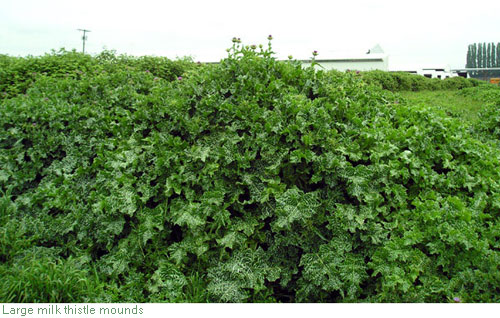
While we're on the topic, another soil/urine mystery was recently explained to me.  One spring day, walking by a  cabin where someone had lived for the previous six months, I noticed an isolated patch of thriving milk thistle (Silybum marianum).  This cabin had no toilet and the thisle patch was very close to his door step.  This must have been where he relieved himself each night, but I never understood why the thistles thrived in those conditions.  You could also see the milk thistles growing well on the downslope side of compost piles where the leachate would probably accumulate.  I was able to go to an Elaine Ingham talk a few months ago (mind blowing!) and I had a chance to query her about this.  Apparently thistles do best in soils with 50 ppm nitrate.  So they absolutely love to grow in a cherished pee spot.  Interestingly, milk thistle will also accumulate high levels of nitrate and this can be toxic to livestock.

Here are some pictures from the King County, WA, noxious weed website.  I definitely appreciate the enthusiasm over milk thistle here!

Note that the common theme among these pictures is that they're all on dairies where the cows are probably raising the soil nitrate levels a fair amount.


All this is not to say that urine is bad for the soil.  On the contrary, it is an amazing fertilizer, it just has to be used properly. It's hard to think of another well rounded fertilizer which is as easily accessible. If you are metabolizing protein, good news, there will be lots of urea in your urine along with bonus ionic compounds that will deliver potassium, magnesium, calcium and phosphate to the soil. 


Monday, January 26, 2015

The Global Food Market, Political Instability, and Fertilizers

In a globalized world, we all buy our food off the same market. The supply and demand of our world's food stocks dictate the price of food from New York to Sidi Bouzid.  This can be a good thing.  If crops fail in country A, food can still be purchased on the world market from other countries.  The global food market can also be a bad thing.  If country A depends on imported food and then one day countries B, C, D, and E are willing to pay twice as much for this food, the inhabitants of country A better hope they or their government can pony up the extra cash. The following graph from The Economist illustrates just how much of the world is not able to feed themselves without imports.


Even worse than being unable to afford food imports is when a country is actually producing enough food for its inhabitants but because the global market reaches everywhere, the food is exported to places where people are willing to pay higher prices.

The Irish Famine of 1845-49 is a classic example of this scenario. From Ireland's Great Hunger Museum comes this quote:

"'Although the potato crop failed, the country was still producing and exporting more than enough grain crops to feed the population. But that was a “money crop” and not a “food crop” and could not be interfered with.' Up to 75 percent of Irish soil was devoted to wheat, oats, barley and other crops that were grown for export and shipped abroad while the people starved."

To give you an idea of the level of this injustice, here are a few stats about the amount food leaving Ireland. In the first nine months of 1847, a year when over 400,000 Irish starved, 822,681 gallons of butter were shipped to England.  Even more outrageous is the 1,336,220 gallons of grain derived alcohol that were exported during this same 9 month period.

This phenomenon of food exports from hungry regions of the world happens to this day.  A clip from the great movie, Darwin's Nightmare, illustrates the point quite well: http://www.youtube.com/watch?v=reEctoUYW9E&t=2m43s

It's safe to say that the global food market dictates how most people eat.  Sometimes price surges in the market make it exceedingly hard for people to access food.  When people are unable to feed themselves, social unrest often follows.


This graph is from the article Freedom to Riot - On the Evolution of Collective Violence.  It uses data from the book Social Unrest and Popular Protest in England, 1740-1840 by John Archer.  It shows that major outbreaks of social unrest coincide with increases in the price of wheat.  The Y axis should actually read "Average Price of Wheat in Shillings in England and Wales" based on the data. Red lines indicate years with major outbreaks of rioting.  Although these price fluctuations probably had less to do with the global food market of the time period, the graph does show how social unrest and high food prices are related.

Food price spikes and unrest

This next graph is from the now well known paper of the New England Complex Systems Institute, The Food Crises and Political Instability in North Africa and the Middle East.
The dotted red lines indicate the outbreak of food riots and social unrest.  The inset is a graph of the FAO food price index since 1990.  The implication of this graph is that high global food prices helped spark the Arab Spring.  If we recall the first chart from The Economist, the Middle East and Africa are heavily reliant on food imports.  Spikes in global food prices therefore put a lot of strain on this region.  For a more detailed analysis of how declining agricultural production in the midst of the 2011 price increase helped spark the Syrian civil war, check out this older post.

How do fertilizers play into this?  From the graph below it's clear that fertilizer prices spike at the same time as the dramatic increases in the global food prices in 2008 and 2011.   The following graphs were made on Knoema.com using World Bank Commodity Price Data.

The increase in fertilizer prices in 2008 was due to a lot of different factors.

Economic growth in developing countries during this period was accompanied by increased demand for meat and other animal products.  The increased livestock production needed to support this diet requires a lot of grain, and this increase in demand for grains in turn led to more demand for fertilizers.  Subsidized biofuels pushed grain demand even further.  In 2007, 18-20% of all corn grown in the US was used for ethanol.

With the demand for grains and other foods pushing food prices up, farmers in developed countries responded by applying more fertilizer in order to increase yields and profit.  There are diminishing returns on increased fertilizer application, but when corn was at a record high of $6.12 a bushel in 2007, the marginal extra yields from more fertilizer would cover costs and then some.

In the midst of this rise in fertilizer prices, China placed high tariffs on the export of fertilizers.  At the time, China was the world's second largest exporter of phosphorus and the largest exporter of urea.  This was certainly a good move for Chinese farmers as it protected them from the price surge on the global market, but it drove prices for the rest of the world even higher.

Knowing how important easy access to fertilizers is for political stability, numerous countries subsidize fertilizer costs.  This is the case in India, and as detailed in an earlier post, in Malawi.  When fertilizer costs increase, these governments are forced to dig deep into their pockets in order to continue the programs.  The upshot of this is that farmers in these countries do not respond to price increases by using less fertilizer as they still pay the subsidized amount.  Consequently the global market for fertilizers stays high as there is no let up in demand in these countries.

Energy prices also play an enormous role in the fluctuating cost of fertilizers. Synthetic nitrogen production requires 2-3% of the global natural gas supply.  Energy costs were very high in 2007-2008 which of course pushed N fertilizer prices higher.

This is not the only time energy prices have pushed up the price of fertilizers and food.  The graph below charts the food and fertilizer price indices from 1960.  It's possible to see how the 1973 and 1979 oil crises affected both the cost of food and fertilizer.


Eventually, the record breaking fertilizer spike of 2008 subsided.  Farmers were simply unwilling or unable to pay such high prices and fertilizer use decreased.  A similar spike happened again in 2011 along with a more sustained increase in food prices.

There are so many factors at play in the volatile global markets for food and fertilizers.  It's not possible to simply point to rising fertilizer prices as the cause of rising food prices when there are several other important drivers for the supply and demand of global food stocks.  Even with these other factors, there is a definite link between fertilizer prices and food prices. It's very hard to have cheap food when fertilizer is expensive.

Fertilizer price volatility hurts poorer farmers the most. When fertilizer doubles in price a lot of these farmers simply cannot afford to buy fertilizer and consequently produce much less food for themselves and local populations.  When this is combined with an increase in food prices on the global market, these populations have a very hard time accessing food as both domestic and imported sources are expensive.

Because of the dramatic '08 spike in the fertilizer index on the graph above, the food price index spike may not seem that bad. Indeed, for citizens of the US, who pay less on food than anyone else in the world, a mere 6.8% of annual income, the food crises of '08 and '11 were not a big problem.  Say that you lived in Algeria though. You're making the average yearly income of about $4000 USD.  In the fall of 2006 you paid $887 a year on food for your family.  By June of 2008 it would require $1,752 to buy the same food.  Unless you managed to substantially increase your income in that short time period, you're really hurting.  To make the example even clearer, the Algerian situation can be put in terms of a US salary.  If you're making $50,000 annually, in 2006 you would be spending $11,118 on food.  By the food spike of 2011 you're now spending $22,405 on food.  If this happened to consumers in the US one can imagine how angry and unstable the political landscape would become. We have a relatively well functioning democracy which helps to manage the displeasure of our populace. During the food price surge of 2011, there was no political outlet for the enormous frustration that built up under the autocratic regimes of the Middle East.  Within a year the Arab Spring would topple many of these governments:


I think the take away from this is that there is a very real link between political stability and the global food price index for countries that import much of their food. Furthermore, volatility in the fertilizer market contributes to high food prices.  To avoid political problems stemming from dramatic food and fertilizer price increases, domestic self sufficiency in both food production and fertility needs is critical.  The political will to set export tariffs on these products to prevent food/fertility from leaving the country in times of scarcity is another important part of maintaining stability.  Certainly, becoming self-sufficient in food and fertility needs is not something that happens over night, but if the food crises of 2008 and 2011 are a phenomenon that will happen again, countries would do well to start working towards these goals now.


For further reading about the 2008 fertilizer price spike here are a few articles that offer different levels of analysis:

World fertilizer prices drop dramatically after soaring to all-time highs

Factors Contributing to the Recent Increase in U.S. Fertilizer Prices, 2002-08

World fertilizer prices surge 200% in 2007


Wednesday, December 24, 2014

Vegetable garden animated GIFs!

I finally got around to making time lapsed gifs from the photos I took in the vegetable garden last spring.

Here is the side yard with squash, beans and leeks on the right and leeks and brassicas on the left. You can see the weeds are mercifully spared as the season goes on.


This is corn in the front yard.  The front variety is a popcorn and in back is Oaxacan green dent corn. The popcorn didn't grow as tall as the plants I saved the seed from but it still made some good ears.


Here is the backyard squash and tomato patch.  Some Jerusalem artichokes pop up into the frame in mid June.  You can also see some lettuce bolting just below.


I wanted to see a zucchini progressing from flower to harvest.  The first zucchini I started taking photos of got blossom end rot though.  It turned out to be a great opportunity to watch the blossom end rot process - from hopeful flower to rotten mush.  On the 7th and 8th days after the flower has closed, the end of the zucchini becomes very very faintly yellow.  Then on the 9th day it turns a striking yellow.  Each day after that the zucchini slowly rots, with a new segment rotting each day.  I tried to figure out what made the demarcation of each segment.  Was it that the rotting happened at night and stopped during the day?  Did it have to do with when I watered?  I couldn't piece it back together.  Blossom end rot happens when the fruit does not get enough calcium.  The calcium in that part of the garden though is absolutely over the top- 6754 ppm and an 82% calcium base saturation in one half of the back yard and then 5064 ppm and 69% calcium base saturation in the other half. I think what probably happened is the plants were still young at this point and I may not have been doing a great job watering the garden. (It was a big job hand watering it every day -I installed drip irrigation for this season though!)  If the soil dried out a little bit the plant might not have been able access calcium as easily as calcium enters the plants roots passively with water.   This area also tested rather high for phosphorus, 94 ppm (6.9 pH) and 163 ppm (6.6pH)!  Perhaps the calcium was locked up in slightly insoluble calcium phosphate?  I didn't see too many blossom end rot problems after the first few squash though so I think it was just a water issue.


Here's that same video slowed down starting on the 7th day after the flower closed when the zucchini just barely starts to yellow.


Lastly here's a zucchini growing like it's supposed to.


Monday, December 22, 2014

Where do we come from?

The human body is a rather complex operation.  Multiple organ systems lumbering around in a mobile casing which is home to billions of different organisms.  This intricate being is constructed using combinations of chemical elements, the building blocks of our universe.  Eleven different chemical elements make up 99.9% of the mass of a human.    So what is the source for these elements that we must absorb in order to become who we are?  For a great many of these elements it is the soil.

While volunteering for a soils education exhibit, I accosted an unfortunate visitor or two and asked them where the magnesium in their bodies came from.  Interrogating strangers on where they get their nutrients from can feel wierd. It seemed a poster with pictures would be a better way to illustrate the fact that magnesium in our bodies comes from the soil.  So then, to answer all your deep questions as to your origins:


The poster is also the work of one Jessi Barber who works for the education exhibit.  She was kind enough to replace all the photos I had just grabbed off the internet with photos her organization had taken.  She also fixed the text so it was a little more to the point.

Of the elements humans need to live, Oxygen, Carbon, and Hydrogen make up 96% of our bodies.  Nitrogen makes up another 3% which shows why it is such an important fertilizer.  Yet just because other elements represent a smaller fraction of our mass does not mean they our less important.  A human without any Phosphorus will be just as non-existent as a human without Carbon.  

We get 12 of the 18 core elements we need to survive from the soil via plants and animals we eat.  Carbon, the second most abundant elements in our bodies comes from plants and animals we eat, but the source of this carbon is from the air.  Plants photosynthesize carbon dioxide and water to form sugar and then more complex carbohydrates.  

Here are the primary sources of the 18 core elements that compose our body, in order of abundance by mass:

Oxygen - From water we drink and air we breathe
Carbon - From plants which take it out of the air as carbon dioxide
Hydrogen - From water we drink
Nitrogen - From plants which uptake it from SOIL
Calcium - From plants which uptake it from SOIL
Phosphorus - From plants which uptake it from SOIL
Sulfur - From plants which uptake it from SOIL
Potassium - From plants which uptake it from SOIL
Sodium - From salt
Chlorine - From salt
Magnesium - From plants which uptake it from SOIL
Iron - From plants which uptake it from SOIL
Zinc - From plants which uptake it from SOIL
Copper - From plants which uptake it from SOIL
Selenium - From plants which uptake it from SOIL
Manganese - From plants which uptake it from SOIL
Iodine - From iodized salt and sometimes from plants via soil
Molybdenum - From plants which uptake it from SOIL

Whenever plants are harvested, the elements they have absorbed into their tissues are removed from the soil on which they were grown.  These elements must be replaced in the form of fertilizers or compost otherwise the soil will become deficient in the these elements and plant growth will suffer.  Capturing these soil nutrients in our waste streams (like when we compost) is an important way to help maintain the soil fertility of our farmland.

Originally I had written, "The human body cannot survive without 16 key elements".  With this wording you're still in the right if somebody wants to tack on Bromine, Cobalt, Nickel and some other trace elements to this list.  The important thing is to not say, "The human body needs 16 elements to live, no more, no less." I've changed the poster a little to reflect 18 core elements as discussed in this blog post. If we include elements the body will use in extremely trace amounts, 36 elements have been found to play a positive role in human health. I'm sure that number will differ depending on what authority you ask and will fluctuate as new research comes out.

Even something pretty far off our radar such as Rubidium is important for the health of humans....or at least the health of "she goats": Recent progress in exploring the essentiality of the ultratrace element rubidium to the nutrition of animals and man.  Whether or not the body could survive without some of these elements and simply live in poorer health is another question.  If you want to know more about the elements required for human life check out Chapter 16. Ultratrace Minerals in Modern Nutrition in Health and Disease or the wikipedia page, Composition of the Human Body

The number of elements actually found in the human body is usually 42. For a detailed list see this table: Estimated Atomic Composition of the Lean 70-kg Male Human Body. (Somewhat worrisome for the credibility of this source is that they say there are normally 41 elements present and then list 42!)  

Thankfully, if we have access to whole foods grown on fertile soils, we rarely have to think about the amount of specific elements are bodies are recieving.  

Monday, December 15, 2014

Attack of the Killer Bunya Pines

I was in Aquatic Park the other day when I saw this gem:


The tree is Araucaria bidwillii, otherwise known as a bunya pine.  The tree produces male pollen cones and female seed cones.  The female seed cones can get up to a foot in diameter.  In the fall Araucaria bidwillii apparently uses the seed cones to crush hapless passersby.

A denizen of San Francisco on their smart phone, unaware they just narrowly survived an encounter with the killer Araucaria bidwillii 

Lead contamination for the home gardener

I've been wanting to write this post for some time as this is an issue that has come up a lot for me - What does one do if their soil is contaminated with lead (and they happen to be helplessly obsessed with vegetable gardening)?  It can be hard for home gardeners to make an informed decision as to the safety of their yard for cultivation.  Figuring out specific vegetable species to avoid is also difficult to find information about.  I hope this post can be a resource for home gardeners on the following:

1. How to figure out if you have lead in your soil

2. Just how much lead is too much lead

3. What vegetable species should be avoided

4. What can be done to mitigate lead contamination


For the sake of all you busy, hard working folk out there who just want to get to the facts without the explanations, the most important points are in bold.


1. How to figure out if you have lead in your soil

Send a soil sample to UMass Soil Testing Laboratory and order a "routine test" with "organic matter": http://soiltest.umass.edu/

A simple soil test which can cost as little as $15 can tell you the levels of lead in your soil.  There are many laboratories which will analyze your soil for lead, but the best option in my opinion is the UMass Soil lab.  They have always been quick, they are inexpensive, and it's a relatively simple process to send them your sample.

In order to have your soil analyzed by UMass you will first need to collect soil samples.  You can have the lab analyze multiple samples at a time which will allow you to divide your yard into sections you can test individually.   This can really help you pinpoint which areas of your yard have lead contamination, as it may only be a certain portion.  Say for example you suspect your backyard is contaminated but that your front yard is fine, it would be best in this circumstance to test these areas separately. It's important to note that the soil within three feet of a house that had exterior lead paint generally has a much higher lead content than other parts of a home garden.  Take this into account when sampling.  You might want to do one sample around the perimeter of the house, and have your other samples not include this area.

Umass has guidelines for how to properly collect your soil samples here: Sampling Instructions.  You're basically going to use a clean shovel to collect soil from at least 12 random spots in your sample area. The soil is collected from a depth of 6-8 inches.  I generally put the soil directly into a ziplock bag.  You can also use a bucket or any other container.  You need the sum of your samples to be at least a cup worth of soil.  Try to avoid getting roots or other large pieces of biomass in your sample.  Before you send in your sampple you have to let the soil dry out before you ship it. It will distort some of the nutrient tests if you seal a bag of soil when it is wet.  I sometimes spread the soil out on a clean baking pan and put it in an oven at the lowest temperature possible to hasten the drying.

Once your soil sample is dry, mix it well and then place it in a ziplock bag which is labeled with the area you sampled from.  Try to use a clean shovel or other instrument rather than touching the soil with your hands.

Print out this order form from Umass for a basic soil test.  The basic test will tell you many metrics in addition to lead.  This includes: pH, exchangeable acidity, extractable nutrients (P, K, Ca, Mg, Fe, Mn, Zn, Cu, B,  S), extractable lead (Pb), extractable aluminum (Al), cation exchange capacity, and base saturation.  Don't worry if you don't understand what all of those mean, they are not that complicated!  Knowing your soil organic matter levels in addtion to these metrics can be helpful when it comes to mitigating the risks of lead contamination.  For this reason it's a good idea to opt for the $6 organic matter test as well on the order form.

Place your completed order form, your labeled samples in ziplock bags and a check into one of the small boxes available at your local post office.  Then send the package off to the UMass lab.  The results should be emailed to you in under a month.


2. Just how much lead is too much lead for home vegetable gardening.

If you have anything over 100 ppm you should inform yourself about how to minimize the risk of lead exposure from home vegetable gardening.  If closer to 400 ppm you should definitely be taking steps to reduce lead bioavailability and use mulch, additional soil and possibly raised beds to limit contact with contaminated soil.  You should also be selective as to which crops you grow.  Cultivating directly in soil with lead over 400 ppm is a bad idea.

Exposure to lead is a dangerous health risk, especially to children.  Take soil lead contamintaion seriously.

Once you've reached this step you should have some test results that show you the levels of lead in your soil.  The information you are looking for is total estimated lead.  Extracted lead is merely the amount of lead that can be measured by the testing procedure.  Total estimated lead though extrapolates from the extracted lead measurement to tell you the actual amount of lead you have in your soil.  The measurement will either be in ppm (parts per million) or mg/kg (milligrams per kilogram).  These are both the same measurement as there are one million milligrams in a kilogram.  If your test only shows extracted lead here is a table (from the very useful UMass Lead testing and recommendations page) to find out the total estimated lead in your soil:

Lead LevelExtracted LeadEstimated Total Lead
--------------------------------- mg/kg or ppm ---------------------------------
Low        less than 22            less than 299
Medium        22 to 126            300 to 999
High        127 to 293            1000 to 2000
Very High        greater than 293            greater than 2000

Natural levels of lead in soils range from 10 - 50 ppm.  The EPA says that children should not be exposed to bare soil with levels higher than 400 ppm. The danger with bare soil is that children might ingest this soil or breath in dust from the contaminated soil.  At 400 ppm, eating only 1/4 teaspoon of soil per week would put children 6 years or younger over the threshold of safe lead blood levels.  The EPA has deemed soils with lead levels higher than 1200 ppm unsafe for all humans.  Some states are more strict than the EPA.  The University of Massachusetts says 300 ppm is the point at which children and pregnant women should avoid contact with bare soil. Minnesota is even more stringent with a limit of 100 ppm for bare soil where children are present.

So we know that if people are going to be inhaling dust or ingesting soil, 400 ppm is certainly too high for children and pregnant women and 1200 ppm is too high for adults. But how much lead is too much if one wants to grow vegetables?  If growing vegetables entails kicking up lots of dirt and inhaling dust than anything near 400 ppm is too much.  Likewise if one grows root crops that are not peeled or have soil residue on them, than anything near 400 ppm is too much.  Growing vegetables which are prone to absorb lead means that 400 ppm is again too much.  So there are a lot of reasons why it's best to only cultivate if soil lead levels are under 400 ppm.

There are other factors at play though when evaluating the risk of growing vegetables in soils with slight lead contamination. Two soils with the same amount of lead might pose very different levels of risk.  The two main variables are the bioavailability of the lead in your soil and the species of vegetable you are growing. If one's soil has a high pH, with high levels of organic matter and phosphate, then the lead is less bioavailable and there is a lower risk for lead uptake into vegetables.  Avoiding species of vegetables which uptake more lead than others will also lower ones risk.

In a study I will link to below, tomatoes grown in soil with 3470 ppm lead (ridiculously high) had undetectable levels of lead in their fruits.  However the leaf tissue on these plants had 22 ppm lead and the root tissue 715 ppm.  I wanted to use this tomatoe to illustrate that technically you could grow something in a very contaminated soil and because you were selective about the species you were cultivating you would technically be ok.  Personally I would feel like a little leery eating those tomatoes.

Although we have shown a case where tomatoes did not pose a threat to human health in 3470 ppm lead, swiss chard in soil with 910 ppm lead had 24 ppm lead in the leafy parts of the plant we eat.  We can note here that the swiss chard and tomato leaf tissue had a similar amount of lead, but the difference between these two scenarios is that we eat the fruit of the tomato, not the leaf tissue, and the tomato was grown in soil with over three times the amount of lead.

So we're beginning to see why it's hard to come up with a single number at which point crops become unsafe: Different plants uptake different amounts of lead.  In addition, depending on the plant we'll eat the roots, the leaves or the fruit. Root tissue is more likely to contain lead, followed by leaves and then fruit.

The other variable that makes it hard to declare a specific ppm of lead unsuitable for vegetables is bioavailability. Depending on your soil there are different levels of lead "sorption"- this is when the lead is bound to clays or organic matter in the soil and is not available to the plants. The more organic matter (and certain clays) your soil has the more chances there are to lock up lead.  The higher the pH, the more sites there are on clays and organic matter for lead to be locked up and made unavailable.  If a soil has a low pH of 3 or 4 lead is very very bioavailable for plants to pick up.  Of course, if your soil pH is 3 you probably won't be able to grow much of anything in the first place!  But at a pH of 5.8 you could still grow vegetables and your plants would uptake more lead than if your soil pH was 7.

Given all the different variables at play here, it can be hard to know if a soil is safe for growing vegetables solely based on the measure of estimated total lead.  Certainly if a soil has 3,000 ppm lead we know this soil is dangerous to work with.  But if your soil has only slightly elevated levels of lead, say 200 ppm, the following variables play a large role in deciding if soil is safe to cultivate:
-What crops you are growing
-The bioavailability of lead to plants
-If you are exposed to large amounts of dust

If you have over 100 ppm, you can do several things to minimize your risk.  Check out parts 3 and 4 for more informaiton.


3. What vegetable species should be avoided.

Cilantro, Mint, Lemon balm, Epazote, Rhubarb, Swiss Chard, Beets, Mangels, Good King Henry, Orach, Spinach, Carrots, Radish, Onions, Garlic, Leeks, Potatoes, and Turnips should not be cultivated on soil with mild lead contamination.  These vegetables are more likely to absorb lead into edible portions.

Root vegetables in general have higher levels of lead than leafy vegetables.  Leafy vegetables generally have higher levels of lead than fruiting vegetables. 

Root crops in general are problematic for two reasons.  First, unless they are peeled, it is difficult to fully cleanse them of soil (which in our scenarios contains lead).  Second, plants grown on soils with lead tend to have much more lead in their root tissues than in their shoot tissue or fruits.

Leafy greens are safer than root crops as leaf tissues have lower amounts of lead than a plant's root tissue. However if rain, watering, or dust gets contaminated soil on leaves this is a pathway to lead exposure.

The safest type of vegetables to eat are those with fruiting bodies. Plants move very very little lead into fruiting bodies.  These include peppers, eggplants, tomatoes, squash, melons, grapes, berries and tree fruits.  Grains such as corn, wheat, rye, barley, oats, also have a low chance of receiving lead from the plants they grow on.

What about specific species though?  There are some plants which have a tendency to uptake much more lead than others.  This article, Lead levels of edibles grown in contaminated residential soils: a field survey, is a great resource which examines levels of lead absorption in different types of vegetable.  From the results of this survey, the following vegetables should be avoided when cultivating on lead contaminated soil:

Cilantro, Mint, Rhubarb, Lemon balm, Epazote, Swiss Chard (and by extension Beets and Mangels, which are the same species), Carrots, Radish, and Onions

Potatoes were not included in this study but other members of the genus Solanum had high root concentrations of lead so it would probably be best to avoid this crop as well.

Turnip was also not included but other members of the same genus contained high levels of root tissue lead.

Spinach, Good King Henry, and Orach are closely related to Swiss Chard and Epazote so they would seem to have a high chance of heavy lead uptake.

Leeks, Garlics, Chives and other members of the genus Allium should be avoided as another member of this genus, Onion, was shown to readily uptake lead into the edible part of the plant.

There was one instance of cucumbers having high levels of lead, although cucumbers from six other contaminated plots had undetectable levels in the fruiting body.  I have not added this to the list of plants to avoid.

Two members of the Lamiaceae family, Lemon Balm and Mint, seem to easily uptake lead, but another member, Basil did not.  As such it is hard to predict how other Lamiaceae herbs like Oregano, Thyme and Sage would uptake lead. The Basil which did not uptake detectable levels of lead in the study was only in 280 ppm lead so perhaps at higher levels it would behave more like Lemon Balm and Mint.

Unfortunately this field survey leaves out a number of different vegetables and food crops. It would also have been nice to see the pH and organic matter content of the soils to get an idea of the lead bioavailability the plants were exposed to. The survey is the most informative article I have seen on rates of lead absorption in different vegetables though. By reading the article you can see which types of vegetables are indeed safer for growing on mildly contaminated soils.


4. What can be done to mitigate lead contamination.

Take steps to minimize contact with soil such as laying down mulch or a new layer of soil, and prevent dust inhalation by keeping the soil moist.  Adding phosphorus, organic matter and raising the pH of your soil will decrease the bioavailability of lead to vegetable plants.  For soils with over 400 ppm consider growing in raised beds with bottoms that roots cannot penetrate. 

The University of Massachussetts has a great webpage on soil lead with a helpful section on Good Gardening Practices to Reduce Lead Exposure.  If you have lead contamination it's definitely worth checking out their recommendations.

Other great resources can be found here:
Lead in Garden Soils
Lead Contaminated Soils: Minimizing Risks
Gardening on Lead and Arsenic Contaminated soils

There are two ways that the home gardener should aim to minimize exposure to lead: reducing physical contact with contaminated soil and reducing bioavailability of lead to vegetables.

Reducing phycical contact with contaminated soil simply entails putting a barrier between yourself and the soil.  You can acheive this by laying down landscaping fabric, mulch, or new soil on top of the contaminated soil.  If you want to cultivate the soil and there is less than 400 ppm in the soil, what I prefer to do is bring in a few cubic yards of compost and raise the soil level a a few inches. You should also try not to work with the soil when it is extremely dry to prevent dust inhalation.

Reducing bioavailability to vegetables involves three parts: raising soil pH to 7, raising levels of soil organic matter, and adding phosphorus.  The higher the pH, the more lead is bound to certain clays and organic matter, making it less likely plants will take up the lead.  To increase soil pH, add a liming agent like calcium carbonate  or calcium magnesium carbonate (also known as lime and dolomite lime).

Phosphorus in soil will bind with available lead to form lead phosphate, which has very low solubility and is unlikely to be absorbed by plants.  Rock phosphate, bone meal and fish emulsion are usually good sources of phosphorus.  I prefer fertilizers that will break down and release their nutrition gradually.  This decreases losses to leaching.  Pollution of groundwater from excess phopsphorus fertilizer is a serious problem so don't over apply.  If you're soil test shows that you have more than 50 ppm phosphorus you should not apply any additional phosphorus fertilizer.

Lastly aim to get your organic matter levels to 4 or 5%.  Not only will you be immobilizing soil lead, but you will also have an extremely healthy and productive soil once you hit this level of organic matter.  Add manures, organic fertilizers and, most importantly, compost to your soil and your organic matter levels will slowly rise.

Lead is a naturally occuring element in soils.  Often times in urban settings soil lead levels become more elevated than naturally occuring levels.  This can pose a health risk to those wishing to cultivate vegetables.  Keep in mind the following points though and you should be safe:

Don't cultivate on soil with over 400 ppm
Pay close attention to the different types of vegetables that you should not grow (Part 3.)
Take steps to minimize contact with the contaminated layers of soil and reduce lead bioavailability (Part 4.)


Epilogue


If you happened to have eaten vegetables grown on soil with heavy lead contamination or toiled in contaminated soil (I've done both- a lot!)  all is not lost.

First, if you think your child have been exposed to high levels of lead, a simple test can be performed to determine the level of lead in their blood.  Contact your primary physician for more information.

If you're like me and you think you've probably come in contact with lead through your gardening activities there are several ways you might be able to reduce the levels of lead in your body. Eating cilantro has been shown to chelate and remove lead from the body in some studies, while other studies show that it at least protects the body from absorbing lead.  If you recall from Part 3, cilantro was a plant to avoid cultivating due to it's propensity to absorb lead.  Interestingly, of all the plants surveyed in the article I linked to, cilantro had the highest ratio of shoot tissue to root tissue lead, 1:1.6.  In addition to cilantro, chlorella has been shown to help the body eliminate mercury and other heavy metals.

Other than cilantro and chlorella, there are several other foods which are being examined for their ability to help the body eliminate heavy metals.  Just eating healthy is a good start though as research shows that a diet high in vitamins and minerals can help protect against lead absorption.  There are very powerful pharmaceutical chelating agents (EDTA, DMSA etc.) which can be used to remove lead from the human body, but these are not without side affects since they can remove many important elements from the body such as magnesium in addition to heavy metals.

If you're interested in reading the studies yourself, below you'll find various journal articles on foods which support heavy metals elimination.

Studies which examine the role of cilantro in absorption and elimination of heavy metals:

Preventive effect of Coriandrum sativum (Chinese parsley) on localized lead deposition in ICR mice.

Significant mercury deposits in internal organs following the removal of dental amalgam, & development of pre-cancer on the gingiva and the sides of the tongue and their represented organs as a result of inadvertent exposure to strong curing light (used to solidify synthetic dental filling material) & effective treatment: a clinical case report, along with organ representation areas for each tooth.

Effect of cilantro on plasma lead levels and some hematological parameters in rats

Effect of Coriandrum Sativum L. extract on blood and urine lead concentrations in 3-7 year old children
In this study, although blood and urine lead concentrations decreased in children given cilantro extract, similar results occured in children given a placebo. This study of course casts some doubt on cilantro's use in eliminating heavy metals.  The conclusion reads as follows: " According to the results of this study, it seems that Coriandrum Sativum is not effective in lead elimination. Increasing renal lead elimination in both groups of children may be due to other factors like improvement of
nutrition following the education at the beginning of this study."

A study which examines the role of Chlorella in eliminating methylmercury:

Enhanced elimination of tissue methylmercury in Parachlorella beijerinckii-fed mice

Studies examining the role of different vitamins and minerals in heavy metals absorption and elimination:

Intake of magnesium and toxicity of lead: an experimental model

Maternal Blood Lead Concentration, Diet During Pregnancy, and Anthropometry Predict Neonatal Blood Lead in a Socioeconomically Disadvantaged Population

Effects of Micronutrients on Metal Toxicity

Selection of Nutrients for Prevention or Amelioration of Lead-Induced Learning and Memory Impairment in Rats

Preventive and therapeutic role of vitamin E in chronic plumbism

Beneficial effect of combined administration of some naturally occurring antioxidants (vitamins) and thiol chelators in the treatment of chronic lead intoxication

Vitamin C modulates lead excretion in rats.

Lastly, here's a review (that I wish I had found much earlier!) which gives a brief overview of the current research on heavy metals absorption and elimination using different foods and pharmaceuticals:

Chelation: Harnessing and Enhancing Heavy Metal Detoxification—A Review


It's important to remember what this research is NOT saying.  Don't think that because you eat cilantro every now and then, you now have a license to work in 1,000 ppm lead soil.  Stay safe when you're vegetable gardening and make sure you understand the lead situation in your soil.


I hope this post helped answer some questions you might have had about growing vegetables in soil with lead.  If you have further questions, feel free to post a comment!

Monday, November 10, 2014

Photos of the Fankanta demonstration farm

The Fankanta demonstration farm is a place where people can come and learn how to grow food without needing to use hybrid seeds, chemical fertilizers, or pesticides.  Fankanta literally means "prepare yourself" and it is here where people can learn to become more self reliant - to grow food without needing to purchase inputs.  We've all worked extremely hard at Fankanta to get the plants growing well and I wanted to use this post as a photo gallery to show some of the beautiful crops at the demonstration farm.

A bed of Clemson Spineless okra

Upland rice

Okra and corn planted by people who had come to the center for training

Mint in various stages of growing back after being cut. To the right is corn.

Mint with corn behind it

A row of newly planted moringa saplings to the left with corn on the right.

Cucucmbers, corn, watermelons, and bunching onions are all visible in this picture.  We were experimenting with trellising for some of the cucumbers.

Compost windrows from our compost program.

View from up high of the farm.  The foreground is filled with very young citrus, sugar apples, sapoteys, coconuts, and moringa.  There are also some older citrus, mangoes and bananas visible.  In 5 years time or so the area should be a dense orchard.  The annual crops are in beds both in the visible background and behind the trees on the left.

Tuesday, October 21, 2014

Fundraising campaign is up and running

A few days a go we launched a fundraising campaign to support the compost program we've been running, to pay for a new pump, and to expand the Fankanta Agroecology Center's training operations.  If you'd like to watch a little video to learn more about the composting program (or even donate!) you can visit the campaign at www.indiegogo.com/projects/senegalese-compost-program/x/8802010

Here's an update which I also just posted onto our indiegogo page about what has been happening lately at Fankanta.

The organic waste keeps coming in by the cartload.  We recently started a third windrow.  Here is Gabu, in front of Lat Dior the horse as his father Mr. Diouf unloads the day's delivery.


You can see in this picture we're just starting the new windrow.  In the foreground is a recently turned windrow and in the background on the right is part of another windrow.

Three weeks ago we had a meeting with a group of citizens concerned about the state of the environment in Keur Massar, the community where we are located.  
The very next day several community members came by to learn about sustainable farming methods.
Three weeks later we usually have a few community members coming by every day to learn about how to farm without needing to buy expensive inputs.  
Today, Mr. Ndyere and Mr. Ndyalo cleared a bed to plant corn.  Mr. Ndyere raises chickens and Mr. Ndyalo is a market farmer who is growing mostly peppers and cabbage at this point.  They are both interested in learning new farming techniques and have been coming by the Fankanta agroecology center several times a week.
Here the bed is being moistened in preparation for the corn.  Two other communty members who have small farms are helping out.
Yesterday Mr. Chendou planted out this nice bed of corn:

On Saturday we were at the 2014 Africa Social Forum where Lamine was on a panel discussing the role of youth groups in education, skills training and youth development.  Lamine talked about a boy/girl scout trade school and how the Fankanta Agroecology center is training youth in sustainable farming.  Youth unemployment is a problem here in Senegal but with trade schools and programs designed to give people the skills they need to be market farmers, youth groups are working to address the issue.
After the Africa Social Forum we also attended a Scouts meeting to discuss the results of a program where a dilapidated building was restored and compost training courses were given.
Between running the demonstration farm, the composting program, training visitors to the demonstartion farm, and going to various meetings we have been very busy!  With your support of our fundraising campaign though, we will be able to develop our young organization and demonstration farm into an even more important community resource.
A last note about market farming in Senegal.  The last blog post recounted how we sold 120 kilos of radish for 4800 CFA Francs.  Well just today we finished selling a mere two beds of mint for 5000 CFA Francs!  This mint was only transplanted from cuttings about a month ago.  If it was a more mature planting with denser foliage the two beds could have sold at 10,000 Francs.  At $20 USD, that's an extremely lucrative proposition here.  It goes to show that the Senegalese like their mint tea and mint is not as easy to grow in the Sahel as it is in the temperate US. Here's Lamine with the bana bana market woman cutting the mint bed.
Stay tuned - I'll hopefully have an update soon about the crops and trees we're growing at the Fankanta demonstration farm.


Thursday, October 2, 2014

Big Money and the Bana Banas

So, you want know how to rake in a cool 4,800 CFA? Radishes, that's how. (Do yourself a favor and don't worry about the exchange rate there.)  Market farmers on the periphery of Dakar generally don't sell their produce themselves.  Instead bana banas, market women, come to the farms, buy what they think they can sell, and bring that produce to market.  Bana bana is the Wolof term for any small retail vendor, vegetable sellers included.
Last week a group of bana banas came by the Fankanta agroecology center.  They asked me, "Do you have any... " and then said something in wolof which meant absolutely nothing to me.  "No", I replied, "but we do have radishes!"

In fact we had several hundred kilos of radishes in the ground and ready to be harvested.  Now radishes are great and all, but it's hard to get excited about eating your way through even ten kilos.  I was so very happen then, that the bana banas wanted to take them off our hands.  The women even wanted to buy the whole crop - perfect.


The women went through and picked the radishes they deemed acceptable.  They ended up pulling out 150 kg.  Afterwards they crammmed an impressive amount into buckets which they carry off on their heads.  The rest they stuffed into sacks and hauled out on a donkey cart.  In all I estimate they actually ended up taking around 120 kg.

Sometimes the radish market is up and sometimes it's down.  If you went ahead and converted the CFA to USD like I told you not to you know where the market is now!  This brings to mind the following Mitchell and Webb Situation sketch that one Mr. Brett Blake showed me years ago.  A note of caution to our more respectable readers; there is a swear word!


In other exciting news, the organization I'm working with is now online! www.oasisgrowbiointensive.org. It's a bit like the death star in Return of the Jedi - still under construction yet fully operational.  Check it out. If you don't like to read, there are pictures!

Check back in next week and I'll have an important announcement for you.  Thanks for stopping by.